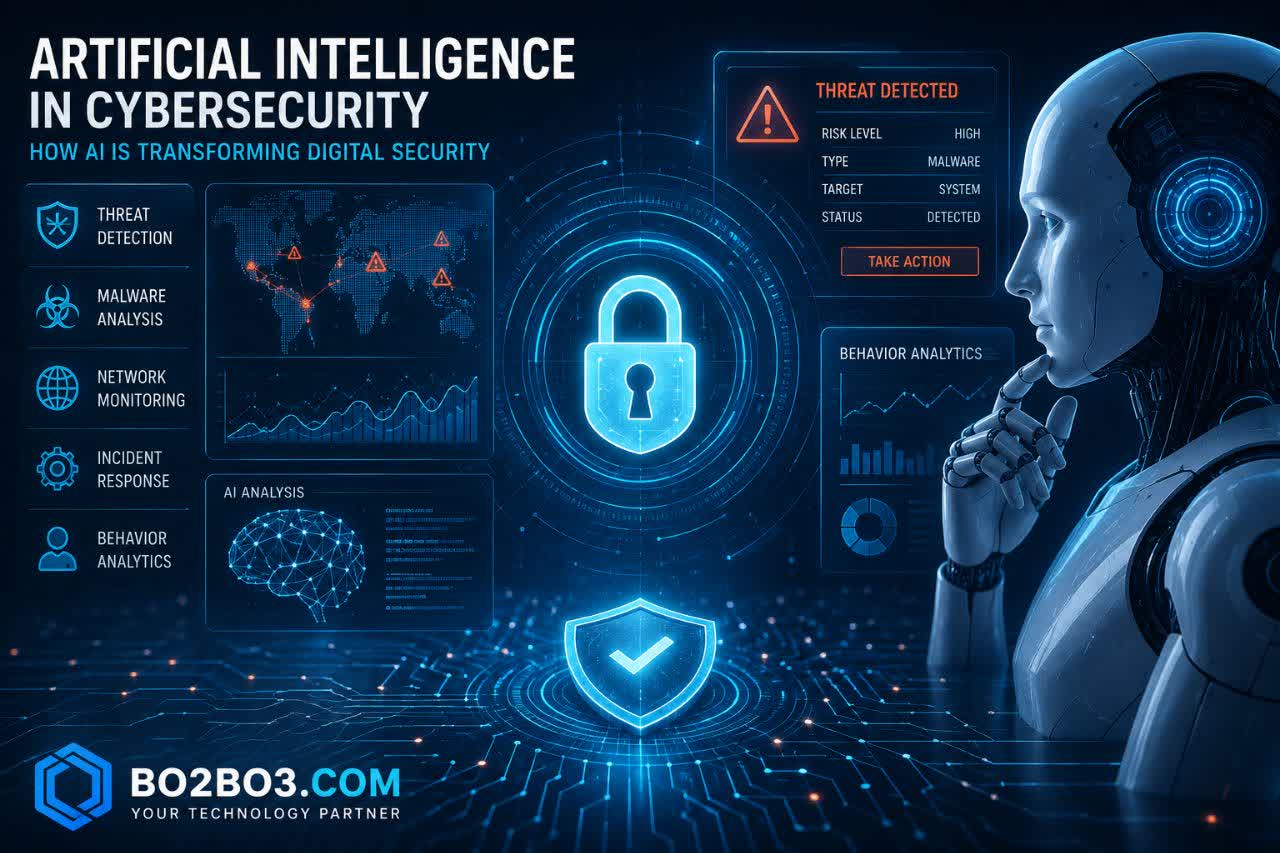
Artificial Intelligence in Cybersecurity: How AI Is Transforming Digital Security
Cybersecurity has become one of the most important challenges in the digital world. As businesses, governments, and individuals increasingly depend on connected technologies, cyber threats are becoming more sophisticated, automated, and difficult to detect. Traditional cybersecurity solutions are often unable to respond quickly enough to modern attacks. This is where Artificial Intelligence (AI) is becoming a powerful technology for improving cybersecurity.
Artificial intelligence can analyze enormous amounts of data, identify unusual behavior, detect potential threats, and help security teams respond to attacks more quickly. From malware detection and network monitoring to fraud prevention and automated incident response, AI is changing the way organizations protect their digital infrastructure.
In this article, we explore how artificial intelligence is used in cybersecurity, its major benefits, limitations, applications, and the future of AI-powered digital security.
What Is Artificial Intelligence in Cybersecurity?
Artificial intelligence in cybersecurity refers to the use of AI technologies such as machine learning, deep learning, natural language processing, and behavioral analysis to identify, prevent, and respond to cyber threats.
Instead of relying only on predefined security rules, AI systems can analyze patterns and learn from large datasets. This allows security platforms to identify suspicious activities that may not match previously known attack signatures.
For example, an AI-powered security system can monitor thousands of login attempts and detect unusual behavior, such as a user suddenly accessing systems from an unfamiliar location or attempting to access sensitive resources at an unusual time.
Why Is AI Important for Cybersecurity?
The volume of digital information generated every day is enormous. Security systems must process network traffic, authentication events, application logs, endpoint activity, emails, and many other sources of information.
Human security analysts cannot manually examine all of this information. Artificial intelligence can help by automatically processing large datasets and identifying patterns that deserve further investigation.
AI can provide several important advantages:
- Faster detection of suspicious activities
- Automated analysis of large datasets
- Identification of unusual user behavior
- Improved malware detection
- Faster incident response
- Reduction of repetitive security tasks
- Improved threat intelligence
- Better prioritization of security alerts
How Machine Learning Is Used in Cybersecurity
Machine learning (ML) is one of the most important technologies behind AI-powered cybersecurity. Machine learning algorithms can learn patterns from historical data and use those patterns to identify potentially malicious activity.
There are several approaches to machine learning in cybersecurity. Supervised learning can be trained using examples of legitimate and malicious activity. Unsupervised learning can identify unusual patterns without requiring every threat to be previously labeled.
For example, an unsupervised machine learning system may discover that a particular device behaves very differently from other devices on the network. Security analysts can then investigate the activity.
AI-Powered Malware Detection
Malware remains one of the most common cybersecurity threats. Traditional antivirus solutions often rely on signatures that identify known malicious files. However, attackers can modify malware to create new variants.
Artificial intelligence can improve malware detection by analyzing characteristics and behaviors rather than relying exclusively on known signatures.
Machine learning models can examine files, processes, network connections, and other indicators to estimate whether an activity is potentially malicious.
This approach can be particularly useful for detecting previously unseen threats and suspicious behavior.
Artificial Intelligence and Ransomware Detection
Ransomware attacks can cause significant disruption by encrypting files and demanding payment from victims. Detecting ransomware activity at an early stage is therefore extremely important.
AI-powered security systems can monitor file-system activity, process behavior, network communications, and unusual encryption patterns. If an application suddenly starts modifying large numbers of files in an abnormal way, an AI system can generate an alert or trigger an automated security response.
AI does not eliminate ransomware risk, but it can help organizations detect suspicious behavior faster and potentially reduce the impact of an attack.
AI for Network Security
Modern networks generate enormous amounts of traffic. Monitoring this traffic manually is practically impossible for large organizations.
AI can analyze network activity and identify anomalies such as unusual connections, unexpected traffic patterns, suspicious communication between systems, and potential attempts to compromise network resources.
AI-based Network Detection and Response systems can use behavioral information to identify activity that may indicate an attack.
AI and Intrusion Detection Systems
Intrusion Detection Systems, commonly known as IDS, are designed to identify potentially malicious activity within networks or systems.
AI can improve intrusion detection by learning what normal network behavior looks like and identifying deviations from that baseline.
This is particularly valuable because modern attacks may not always match known signatures. Behavioral analysis can provide another layer of defense.
AI for Phishing Detection
Phishing attacks attempt to trick users into revealing sensitive information such as passwords, financial details, or authentication codes.
AI can analyze emails, websites, URLs, message content, sender behavior, and other signals to identify characteristics associated with phishing attacks.
Natural language processing can also help security systems analyze the language used in suspicious messages. When combined with other security signals, AI can improve the ability to detect potentially dangerous communications.
Artificial Intelligence in Identity and Access Security
Identity security is another important area where AI can provide significant benefits.
AI systems can analyze login behavior and detect anomalies. For example, if an account normally logs in from one region during business hours but suddenly attempts multiple logins from an unfamiliar location, the activity may be considered suspicious.
Organizations can combine AI-based behavioral analysis with multi-factor authentication, access controls, and other security technologies to strengthen identity protection.
User and Entity Behavior Analytics
User and Entity Behavior Analytics (UEBA) focuses on identifying unusual behavior by users, devices, applications, and other entities.
AI can establish behavioral baselines and continuously monitor changes. This can help security teams identify potential insider threats, compromised accounts, or unusual system activity.
For example, if an employee suddenly downloads a very large amount of sensitive information that is inconsistent with their normal behavior, an AI-powered system may flag the activity for investigation.
AI in Security Operations Centers
Security Operations Centers, or SOCs, are responsible for monitoring and responding to cybersecurity incidents. Security analysts often receive thousands of alerts every day.
One of the major advantages of AI is its ability to help security teams prioritize these alerts.
Instead of treating every alert equally, AI systems can correlate information from multiple sources and help determine which events are more likely to represent serious threats.
This can reduce alert fatigue and allow security professionals to focus their attention on the most important incidents.
Automated Incident Response
Detecting a threat is only part of cybersecurity. Organizations must also respond quickly.
AI can support automated incident response by triggering predefined actions when certain suspicious conditions are detected. Depending on the security architecture, these actions may include isolating an endpoint, blocking suspicious network traffic, disabling a compromised account, or escalating an incident to a security analyst.
Human oversight remains important, particularly for high-impact decisions.
AI and Threat Intelligence
Threat intelligence involves collecting and analyzing information about cyber threats, attackers, vulnerabilities, and attack techniques.
AI can process large quantities of threat intelligence data from multiple sources and identify relationships between different indicators.
This can help organizations understand emerging threats and improve their defensive strategies.
Generative AI and Cybersecurity
Generative AI is introducing new opportunities for cybersecurity teams. Large language models can help analysts summarize security alerts, explain technical information, generate reports, and assist with security investigations.
Generative AI can also help security professionals analyze large amounts of documentation and convert complex technical information into easier-to-understand explanations.
However, generative AI must be used carefully. Organizations should implement appropriate access controls, data protection policies, validation procedures, and human oversight.
Benefits of Artificial Intelligence in Cybersecurity
The combination of artificial intelligence and cybersecurity can provide several significant advantages.
1. Faster Threat Detection
AI can analyze security events continuously and identify suspicious patterns faster than manual analysis.
2. Processing Large Amounts of Data
Modern organizations generate huge volumes of security information. AI can process this information at a scale that would be difficult for human teams to manage alone.
3. Improved Threat Detection
Machine learning can identify behavioral patterns and anomalies that traditional signature-based systems may overlook.
4. Automation
AI can automate repetitive security operations, allowing cybersecurity professionals to spend more time on complex investigations and strategic activities.
5. Reduced Response Time
Automated detection and response capabilities can reduce the time between identifying a potential threat and taking defensive action.
Challenges of Using AI in Cybersecurity
Despite its advantages, AI is not a perfect solution. Organizations must understand its limitations before deploying AI-based security systems.
False Positives
AI systems can sometimes classify legitimate activity as suspicious. Excessive false positives can increase the workload of security teams.
False Negatives
An AI system may also fail to recognize certain sophisticated attacks. For this reason, AI should be considered an additional security capability rather than a complete replacement for cybersecurity expertise.
Data Quality
Machine learning models depend heavily on the quality of their training and operational data. Poor-quality or biased data can reduce model effectiveness.
Adversarial Attacks
Attackers may attempt to manipulate AI systems by creating inputs designed to cause incorrect predictions. This is an important area of research in AI security.
Privacy Concerns
AI-powered monitoring can involve processing sensitive information. Organizations must ensure that data collection and analysis comply with applicable privacy and security requirements.
AI Versus Traditional Cybersecurity
Traditional cybersecurity technologies remain important. Firewalls, antivirus software, access controls, encryption, vulnerability management, and security policies continue to play fundamental roles.
AI should therefore be viewed as a technology that enhances existing security capabilities rather than completely replacing traditional security controls.
A modern cybersecurity strategy can combine traditional controls with AI-based monitoring, behavioral analytics, automation, and threat intelligence.
The Future of AI in Cybersecurity
The relationship between artificial intelligence and cybersecurity is expected to become increasingly important as digital systems become more complex.
Future security platforms are likely to use AI more extensively for continuous monitoring, threat detection, vulnerability prioritization, identity protection, and automated response.
