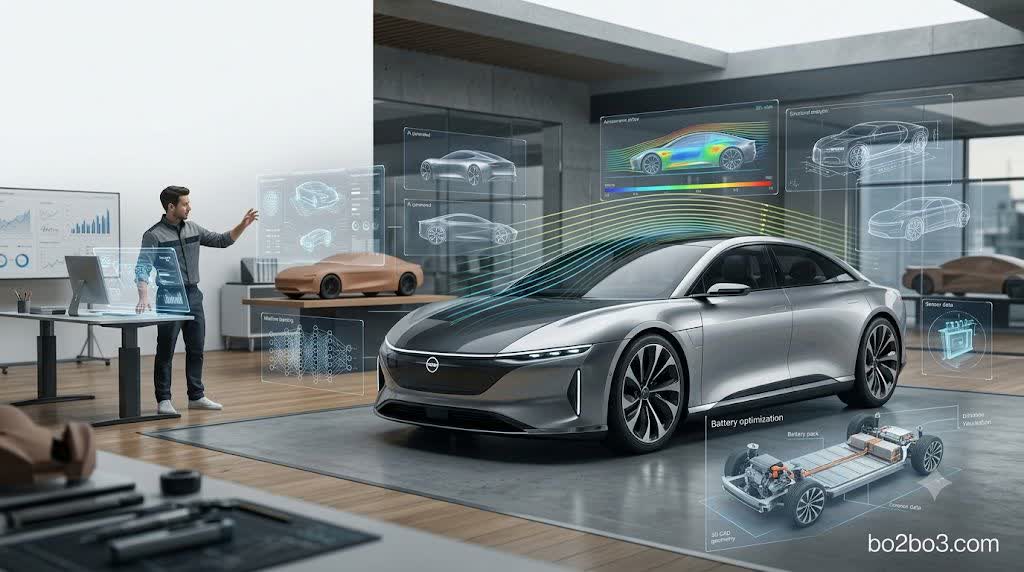
Artificial Intelligence and Its Role in Designing the Cars of the Future
Artificial Intelligence (AI) is rapidly transforming the automotive industry, changing not only how vehicles are manufactured but also how future cars are imagined, engineered, tested, and operated. From generative vehicle design and aerodynamic optimization to autonomous driving, predictive maintenance, intelligent safety systems, and personalized passenger experiences, AI is becoming one of the most important technologies shaping the next generation of automobiles.
The traditional automotive design process can require years of engineering, simulation, physical prototyping, testing, and optimization before a new vehicle reaches production. Artificial intelligence can significantly accelerate many of these stages by analyzing enormous amounts of engineering and operational data, identifying patterns, generating alternative designs, and helping engineers make better decisions.
The combination of artificial intelligence, machine learning, generative AI, computer vision, digital twins, and advanced simulation is creating a new approach to automotive engineering. These technologies allow designers and engineers to explore a much larger number of possible vehicle configurations while reducing development time and potentially lowering costs.
What Is AI-Powered Car Design?
AI-powered car design refers to the use of artificial intelligence, machine learning, deep learning, generative AI, optimization algorithms, and related technologies throughout the vehicle development process.
Instead of relying exclusively on conventional engineering workflows, AI systems can explore thousands or even millions of possible design configurations. These systems can evaluate different combinations of dimensions, materials, aerodynamic characteristics, energy consumption, safety requirements, manufacturing constraints, and user preferences.
For example, an AI system could receive requirements such as:
- Low aerodynamic drag
- High passenger safety
- Long electric driving range
- Low vehicle weight
- Efficient battery packaging
- Modern exterior styling
- Low manufacturing cost
- High structural strength
The system can then generate and evaluate multiple design concepts while engineers select, modify, and validate the most promising solutions.
How Artificial Intelligence Is Changing Automotive Design
Artificial intelligence is not simply replacing automotive engineers. Instead, it is becoming a powerful engineering tool that can expand the design space and accelerate decision-making.
A conventional design team may evaluate a limited number of alternatives because each simulation or physical prototype requires significant time and resources. AI can act as a high-speed exploration system, identifying promising configurations before expensive computational fluid dynamics simulations, structural analysis, wind-tunnel testing, or physical prototypes are produced.
This human-AI collaboration can allow automotive companies to develop innovative vehicle concepts faster while maintaining engineering control over the final product.
Generative AI and the Design of Future Cars
One of the most exciting applications of artificial intelligence in automotive design is generative AI.
Generative AI can create new design concepts from textual descriptions, images, engineering parameters, or existing design data. Instead of simply modifying an existing vehicle model, generative systems can explore entirely new design alternatives.
For example, a designer could specify a concept such as:
Create a compact electric vehicle optimized for urban transportation, with low aerodynamic drag, a spacious interior, high visibility, and an efficient battery layout.
An AI design system could generate numerous visual and engineering concepts that satisfy different aspects of these requirements.
However, visual appeal alone is not sufficient for a production vehicle. AI-generated designs must eventually satisfy engineering constraints such as crash safety, manufacturability, aerodynamics, thermal management, structural strength, regulatory requirements, and production cost.
Artificial Intelligence and Automotive Aerodynamics
Aerodynamics is one of the most important factors influencing the performance and efficiency of modern vehicles, particularly electric vehicles.
Reducing aerodynamic drag can improve energy efficiency and increase driving range. Traditionally, automotive aerodynamic development relies heavily on computational fluid dynamics (CFD), wind-tunnel experiments, and iterative geometric optimization.
AI can accelerate this process by learning relationships between vehicle geometry and aerodynamic performance.
An AI model can be trained using large datasets containing vehicle shapes and their corresponding aerodynamic results. Once trained, the model can rapidly estimate the aerodynamic performance of new designs, allowing engineers to screen a large number of alternatives before conducting more expensive high-fidelity simulations.
In the future, AI could help engineers optimize vehicle shape, cooling requirements, stability, energy efficiency, and passenger comfort simultaneously.
AI and Electric Vehicle Design
The transition toward electric mobility is creating new opportunities for AI-assisted vehicle design.
Electric vehicles have different engineering requirements from conventional internal combustion vehicles. Battery capacity, thermal management, electric motors, regenerative braking, vehicle weight, energy consumption, and charging requirements must all be considered during development.
AI can help engineers optimize the interaction between these components.
Machine learning models can analyze driving conditions and energy-consumption data to identify design configurations that maximize vehicle efficiency. AI can also support battery thermal-management strategies and help predict battery degradation.
Future vehicle platforms may use AI to optimize the complete energy system rather than treating the battery, electric motor, cooling system, and aerodynamic design as completely separate engineering problems.
AI-Based Interior Design
Artificial intelligence will also influence the interior design of future vehicles.
Traditional vehicle interiors are designed around relatively fixed controls and interfaces. Future vehicles may instead use AI to create highly adaptive environments.
AI could analyze passenger preferences and automatically adjust:
- Seat position
- Climate control
- Lighting
- Infotainment settings
- Navigation preferences
- Audio configuration
- Display layouts
- Driver assistance settings
In highly automated vehicles, interior design could change dramatically because the traditional driver-focused cockpit may become less important. Depending on the level of automation and applicable regulations, future vehicles could provide flexible spaces optimized for working, relaxing, entertainment, or social interaction.
AI and Autonomous Vehicle Design
Artificial intelligence is particularly important for autonomous vehicles because self-driving systems must continuously interpret their environment and make decisions.
Modern autonomous driving research uses machine learning for perception, prediction, planning, and control. Computer vision systems can identify vehicles, pedestrians, road markings, traffic signals, and other objects.
Machine learning models can also estimate how surrounding road users may behave and help determine appropriate vehicle actions.
This means that future automotive engineering will increasingly involve designing not only mechanical systems but also intelligent decision-making systems.
AI and Vehicle Safety
Safety is one of the most important reasons for integrating artificial intelligence into future vehicles.
AI-based driver assistance systems can process information from cameras, radar, lidar, ultrasonic sensors, GPS, and other sources. These systems can help detect potential hazards and provide warnings or automated interventions.
Artificial intelligence can also be used during vehicle development to identify potential safety problems before production.
Engineers can use AI-assisted simulation to investigate crash scenarios, structural behavior, thermal events, and other safety-related conditions.
Nevertheless, AI-generated or AI-assisted engineering decisions must be independently validated. Safety-critical automotive systems cannot rely solely on statistical predictions from an AI model.
AI and Digital Twins in Automotive Engineering
A digital twin is a virtual representation of a physical vehicle or system that can be updated using real-world data.
When artificial intelligence is combined with digital twins, engineers can create an intelligent feedback loop between vehicle design, simulation, testing, production, and real-world operation.
Data collected from vehicles operating on the road can be analyzed by AI. The results can then be used to identify component degradation, unexpected behavior, energy-consumption patterns, or opportunities for design improvement.
AI for Lightweight Vehicle Design
Vehicle weight has a major impact on energy consumption, performance, and efficiency.
AI-assisted topology optimization and generative engineering can help engineers discover structures that use less material while maintaining required strength and stiffness.
This approach can be particularly valuable for electric vehicles because reducing weight can contribute to improved efficiency and potentially longer driving range.
AI and Smart Materials
The future of automotive design may also involve AI-assisted material selection.
Vehicle engineers must choose materials according to strength, weight, cost, thermal behavior, durability, recyclability, and manufacturing requirements.
AI can analyze large material databases and identify promising material combinations for specific engineering objectives.
AI in Vehicle Manufacturing
AI-driven vehicle design is closely connected to intelligent manufacturing.
Once a vehicle design has been created, artificial intelligence can continue to support manufacturing through quality inspection, predictive maintenance, process optimization, robotics, and production planning.
Machine vision systems can inspect components for defects at high speed. Machine learning can identify patterns associated with manufacturing problems, allowing factories to correct processes before defects become widespread.
AI and Predictive Maintenance
Future vehicles will increasingly generate large amounts of operational data.
Artificial intelligence can analyze this information to identify unusual patterns that may indicate component degradation or potential failure.
Instead of following only fixed maintenance schedules, future vehicles could increasingly use condition-based or predictive maintenance.
An AI system could estimate that a component is beginning to operate outside its normal performance range and recommend inspection before a serious failure occurs.
AI and Personalized Mobility
Future cars may become increasingly personalized.
Instead of designing one fixed vehicle configuration for millions of customers, manufacturers could use AI to analyze customer requirements and generate vehicle configurations optimized for different use cases.
One customer might prioritize range and comfort, while another might prioritize performance, cargo capacity, or urban maneuverability.
From Software-Defined Vehicles to AI-Defined Vehicles
The automotive industry is increasingly moving toward software-defined vehicles, in which software plays a central role in vehicle functionality.
The next step may be the emergence of vehicles in which AI becomes a central layer connecting multiple vehicle systems.
Instead of isolated software functions, AI could coordinate navigation, energy management, climate control, driver assistance, infotainment, maintenance, and personalization.
The Role of Human Designers in an AI-Driven Automotive Industry
Although AI can generate thousands of design alternatives, human expertise will remain essential.
Automotive design involves more than optimization. A successful vehicle must communicate identity, emotion, usability, cultural meaning, and brand values.
AI can generate possibilities, but humans must decide which solutions are appropriate, desirable, ethical, safe, and commercially viable.
Challenges of Using AI in Future Car Design
1. Safety and Reliability
AI models can produce incorrect predictions or unexpected outputs. In safety-critical systems, even rare failures can have serious consequences.
2. Explainability
Some advanced AI systems operate as complex models whose decision-making processes can be difficult to interpret. Engineers and regulators may require clear explanations for safety-critical decisions.
3. Data Quality
AI performance depends heavily on the quality and diversity of training data. Biased, incomplete, or inaccurate datasets can produce unreliable results.
4. Cybersecurity
Connected and AI-powered vehicles create new cybersecurity risks. Protecting vehicle software, sensors, communication systems, and personal data will be essential.
5. Regulatory Compliance
Vehicle designs must comply with safety and technical regulations. AI-generated concepts must therefore be translated into engineering solutions that satisfy applicable standards.
6. Manufacturing Feasibility
An AI system may generate an attractive or theoretically efficient design that is difficult or expensive to manufacture. AI-based design must therefore incorporate manufacturing constraints from the beginning.
7. Human Trust
Consumers must understand and trust AI-powered vehicle systems. Building that trust requires transparency, robust testing, clear communication, and demonstrable safety performance.
The Future of AI-Based Automotive Design
The future of automotive design is likely to involve increasingly integrated AI systems.
A future engineering platform could combine generative AI, CAD, computational fluid dynamics, structural simulation, digital twins, manufacturing data, real-world vehicle data, and human engineering expertise in one continuous development environment.
An engineer could describe a target vehicle in natural language, and AI could generate multiple concepts. The system could then automatically evaluate aerodynamics, weight, energy efficiency, structural performance, thermal behavior, manufacturing feasibility, and cost.
The most promising designs could be converted into detailed CAD models and subjected to high-fidelity simulations and physical testing.
Will AI Completely Design Cars in the Future?
It is unlikely that artificial intelligence will completely eliminate the need for human automotive engineers and designers in the foreseeable future.
Instead, AI will probably become a highly capable engineering assistant.
AI will handle increasingly large portions of data analysis, optimization, simulation support, concept generation, testing analysis, and predictive modeling.
Humans will remain responsible for defining objectives, evaluating trade-offs, validating safety, making strategic decisions, and ensuring that the final vehicle satisfies technical and social requirements.
Conclusion
Artificial intelligence is becoming a fundamental technology in the design of future cars. Its influence extends from the earliest stages of vehicle concept development to aerodynamic optimization, structural engineering, electric vehicle design, autonomous driving, manufacturing, safety, predictive maintenance, and personalized mobility.
Generative AI is opening new possibilities for automotive styling and engineering, while machine learning is enabling more efficient optimization and prediction. Digital twins and connected vehicles can create continuous feedback between real-world operation and future vehicle development.
However, the future of AI-powered automotive design will depend on responsible engineering. AI-generated designs must be validated through physics-based simulation, physical testing, regulatory assessment, cybersecurity measures, and human expertise.
The most important transformation may therefore not be the replacement of automotive engineers by artificial intelligence, but the creation of a new engineering workflow in which humans and AI work together.
As AI technologies become more capable, future vehicles are likely to become more intelligent, efficient, adaptive, connected, personalized, and potentially safer. The automobile of the future may ultimately be designed through a combination of human creativity, engineering knowledge, real-world data, and artificial intelligence.
Frequently Asked Questions About AI and Future Car Design
How is artificial intelligence used in car design?
Artificial intelligence is used for generative design, aerodynamic optimization, structural analysis, material selection, autonomous driving development, predictive maintenance, safety analysis, manufacturing optimization, and personalization.
Can AI design a complete car?
AI can generate and optimize many aspects of a vehicle concept, but a production vehicle still requires engineering validation, safety testing, manufacturing assessment, regulatory compliance, and human decision-making.
How does generative AI affect automotive design?
Generative AI can rapidly create multiple vehicle concepts based on design and engineering requirements. It allows designers to explore a much larger design space than traditional manual workflows.
Will AI make future cars safer?
AI has the potential to improve safety through advanced driver assistance, perception, predictive systems, automated emergency responses, and improved engineering analysis. However, safety benefits depend on system reliability, validation, appropriate deployment, and regulatory oversight.
How will AI affect electric vehicle design?
AI can help optimize battery systems, energy consumption, vehicle weight, aerodynamics, thermal management, electric powertrains, and overall vehicle architecture.
What is the relationship between AI and autonomous vehicles?
AI is a core technology for autonomous driving because machine-learning systems can process sensor information, recognize objects, predict the behavior of other road users, and assist with driving decisions and trajectory planning.
References and Further Reading
- Prompt-guided diffusion approach for deep generative vehicle designs under user-defined specifications . Journal of Computational Design and Engineering, 2026.
- A design method for electric vehicle front face styling based on engineering feasibility optimization of GenAI-generated images . Expert Systems with Applications, 2026.
- Ranging from prediction to planning via machine learning approaches for autonomous driving: a survey . Artificial Intelligence Review, 2026.
- Artificial intelligence and machine learning in autonomous driving: current trends and future directions . Journal of Engineering and Applied Science, 2026.
- A generative-AI-based design methodology for car frontal forms design . Advanced Engineering Informatics, 2024.
- AI and VR in automotive design: a circular approach for efficient next-generation development . Discover Applied Sciences, 2026.
- Automated Vehicle Safety . National Highway Traffic Safety Administration (NHTSA).
- Modernizing Safety Standards for Automated Vehicles . National Highway Traffic Safety Administration.
SEO Information
SEO Title: Artificial Intelligence and the Future of Car Design
Meta Description: Discover how artificial intelligence is transforming future car design through generative AI, autonomous driving, aerodynamics, EV optimization, safety, and smart vehicle engineering.
Focus Keyword: AI in Future Car Design
Secondary Keywords: Artificial Intelligence in Automotive Design, AI-Powered Cars, Future Cars, Generative AI Car Design, AI Automotive Technology, Autonomous Vehicles, AI Electric Vehicles
Suggested URL Slug: ai-future-car-design
