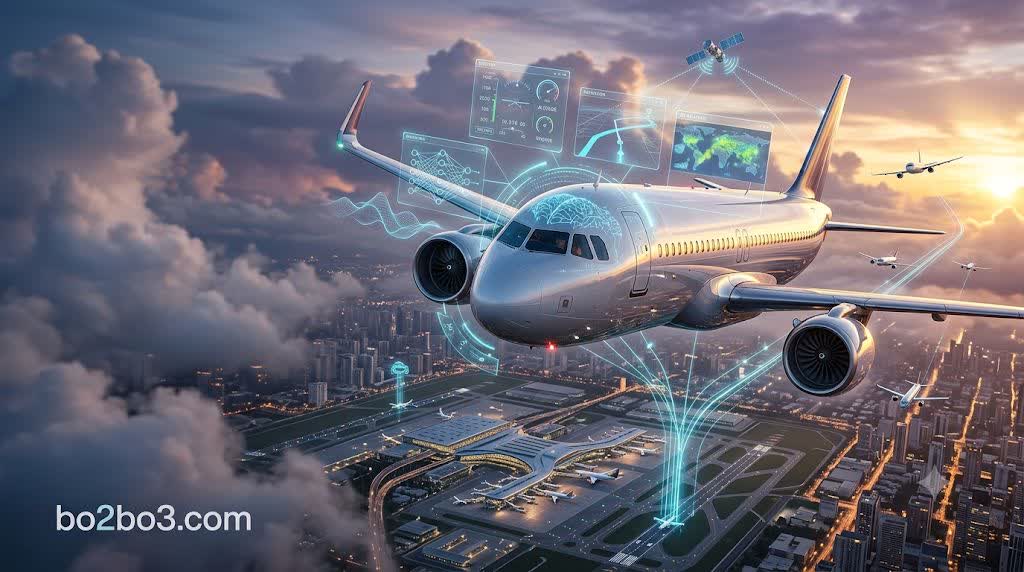
Artificial Intelligence and Its Applications in the Aviation Industry
Artificial Intelligence (AI) in aviation is rapidly transforming the global aviation industry. From predictive aircraft maintenance and flight planning to air traffic management, airport operations, aviation safety, cybersecurity, and passenger services, AI is becoming an increasingly important technology for modern aviation.
What Is Artificial Intelligence in Aviation?
Artificial Intelligence in aviation refers to the use of technologies such as machine learning, deep learning, computer vision, predictive analytics, natural language processing, and intelligent automation to analyze aviation data and support operational decisions.
Modern aircraft generate enormous amounts of data through sensors, navigation systems, engines, flight-control systems, communication equipment, and other onboard technologies. Airports, airlines, air traffic management organizations, and maintenance companies also generate large volumes of operational information.
AI systems can process this information and identify patterns that may be difficult to detect through traditional methods. This makes artificial intelligence particularly valuable for an industry where safety, efficiency, reliability, and precise decision-making are essential.
The European Union Aviation Safety Agency (EASA) is actively researching and developing approaches for the safe and human-centric adoption of artificial intelligence in aviation.
Why Is AI Important for the Aviation Industry?
Aviation is one of the most complex transportation industries in the world. Every flight involves multiple interconnected factors, including aircraft performance, weather, airspace capacity, airport infrastructure, passenger demand, fuel consumption, maintenance requirements, and crew availability.
Traditional software systems generally operate according to predefined rules. Artificial intelligence can complement these systems by analyzing large datasets, identifying patterns, making predictions, and providing decision-support capabilities.
Some of the most important benefits of AI in aviation include:
- Improved aviation safety
- Predictive aircraft maintenance
- More efficient flight planning
- Better air traffic management
- Reduced operational delays
- Improved airport resource management
- Reduced fuel consumption
- Enhanced cybersecurity
- Improved passenger experience
- More efficient aircraft operations
- Advanced automation
- Support for sustainable aviation
Artificial Intelligence for Predictive Aircraft Maintenance
One of the most promising applications of artificial intelligence in aviation is predictive aircraft maintenance.
Modern aircraft contain thousands of components and sensors that continuously generate operational information. This data can include engine temperature, vibration, pressure, fuel consumption, hydraulic parameters, electrical measurements, flight cycles, and other technical indicators.
Machine learning algorithms can analyze historical maintenance records together with aircraft sensor data to identify patterns associated with component degradation or potential failures.
Instead of waiting for a component to fail, predictive maintenance can help maintenance teams identify potential problems at an earlier stage.
For example, an AI system could detect an unusual combination of engine temperature, vibration, and pressure measurements and notify engineers that a component may require additional inspection.
This approach can potentially reduce unscheduled maintenance, aircraft downtime, operational disruptions, and maintenance costs.
AI in Aircraft Engine Monitoring
Aircraft engines are among the most complex and highly monitored systems in aviation. Every flight generates large amounts of engine performance data.
Artificial intelligence can compare current engine parameters with historical operational patterns and identify unusual behavior.
Machine learning models can potentially detect early signs of abnormal performance and provide maintenance teams with additional information for inspection and decision-making.
The combination of aircraft sensors, big data, cloud computing, and AI is creating new opportunities for more efficient aircraft maintenance.
Artificial Intelligence in Flight Planning
Flight planning requires the analysis of many variables, including weather conditions, aircraft performance, airspace restrictions, airport congestion, fuel requirements, and traffic levels.
AI can process these variables and support airlines in identifying efficient flight trajectories.
Machine learning systems can also analyze historical flight data to identify patterns in flight duration, fuel consumption, weather conditions, and operational delays.
According to EUROCONTROL, artificial intelligence is being explored and applied in areas such as flight planning, trajectory prediction, traffic forecasting, and trajectory optimization.
AI and Air Traffic Management
Air Traffic Management (ATM) is another major area where artificial intelligence can support aviation operations.
Air traffic controllers must continuously monitor aircraft positions, flight trajectories, weather conditions, airspace capacity, airport operations, and potential conflicts.
In busy airspace, the amount of information that must be analyzed can be extremely large.
AI can analyze traffic patterns and provide predictions that help controllers and aviation network managers understand future traffic conditions.
EUROCONTROL identifies several AI applications in aviation and ATM, including traffic forecasting, flight-plan processing, trajectory prediction, conflict detection and resolution, and airport operations.
Artificial Intelligence for Air Traffic Prediction
Accurate air traffic prediction is essential for managing increasingly complex and congested airspace.
Machine learning models can analyze historical flight information, airline schedules, airport capacity, weather conditions, and previous operational disruptions to predict future traffic patterns.
These predictions can help aviation organizations identify potential congestion before it becomes a major operational problem.
Improved traffic forecasting can also support better resource allocation and contribute to reducing unnecessary delays.
AI-Based Aircraft Trajectory Optimization
Aircraft trajectories are affected by weather, aircraft performance, airspace restrictions, air traffic, and other operational factors.
Artificial intelligence can analyze these variables and help identify more efficient flight trajectories.
More efficient trajectories can potentially reduce fuel consumption, improve flight efficiency, and support efforts to reduce the environmental impact of aviation.
Artificial Intelligence and Aviation Safety
Safety is the most important consideration when implementing artificial intelligence in aviation.
Unlike many consumer applications, aviation systems operate in safety-critical environments. An incorrect decision or unexpected system behavior can have serious consequences.
For this reason, AI systems used in safety-related aviation applications require rigorous development, testing, validation, monitoring, and safety assurance.
The EASA Artificial Intelligence Roadmap 2.0 emphasizes a human-centric approach to AI in aviation and addresses areas including safety, security, human factors, ethics, and AI assurance.
The objective is not simply to introduce AI into aviation as quickly as possible. Instead, AI must be integrated into the existing aviation safety framework.
AI as a Decision-Support System for Pilots
Artificial intelligence can support pilots by analyzing large quantities of information and presenting relevant recommendations.
Potential applications include weather analysis, anomaly detection, aircraft performance monitoring, route analysis, risk assessment, and operational decision support.
For example, an AI system could analyze weather information, aircraft performance, and route conditions and highlight potential operational risks for the flight crew.
However, AI should be designed to support rather than unnecessarily replace human expertise. Pilots need to understand both the capabilities and limitations of intelligent systems.
Artificial Intelligence and Autonomous Aircraft
Autonomous aviation is one of the most advanced areas of artificial intelligence research.
AI can potentially allow aircraft and unmanned aerial systems to process sensor information, interpret their environment, plan trajectories, and respond to changing operational conditions.
These technologies are particularly relevant to drones, unmanned aircraft systems, advanced air mobility, and future aviation concepts.
However, fully autonomous commercial passenger aircraft remain a significant technical, safety, and regulatory challenge.
EASA continues to study advanced AI applications and has been developing regulatory and technical approaches for increasingly sophisticated AI systems in aviation.
Read more about EASA’s Artificial Intelligence Concept Paper
AI in Airport Operations
Airports are highly complex environments involving aircraft, passengers, baggage, ground vehicles, security systems, gates, runways, and numerous service providers.
Artificial intelligence can help airports analyze operational data and optimize the use of available resources.
Potential applications include:
- Passenger flow prediction
- Airport congestion prediction
- Aircraft gate allocation
- Aircraft turnaround prediction
- Baggage handling optimization
- Ground operations management
- Runway resource management
- Security monitoring
- Infrastructure inspection
- Airport resource allocation
AI for Aircraft Turnaround Optimization
Aircraft turnaround is the period between an aircraft arriving at an airport and departing for its next flight.
During this period, several operations must be completed, including passenger boarding, baggage handling, cleaning, refueling, catering, technical inspections, and other ground services.
A delay in one operation can affect the entire flight schedule.
AI systems can analyze historical turnaround data and operational conditions to predict whether an aircraft is likely to depart on time.
EUROCONTROL has identified AI-based performance prediction as an area that can support aviation operations, including aircraft turnaround-time prediction.
Artificial Intelligence and Fuel Efficiency
Fuel efficiency is an important economic and environmental issue for airlines.
AI can analyze aircraft performance, flight trajectories, weather conditions, traffic patterns, and other operational data to identify opportunities for more efficient flight operations.
Machine learning can help identify patterns associated with higher fuel consumption and support the evaluation of alternative operational strategies.
AI-assisted trajectory optimization can therefore contribute to more efficient flights while maintaining safety and operational requirements.
AI and Weather Analysis
Weather conditions can have a major impact on aviation operations.
Thunderstorms, turbulence, icing, strong winds, heavy precipitation, and low visibility can affect aircraft routes and airport operations.
Artificial intelligence can analyze large quantities of meteorological and aviation data to support weather-related predictions and operational decision-making.
More accurate predictions can help airlines and air traffic managers plan alternative routes and respond more effectively to changing weather conditions.
Computer Vision in Aviation
Computer vision is a branch of artificial intelligence that allows computers to analyze images and video.
In aviation, computer vision can potentially be used for aircraft inspections, airport security, runway monitoring, baggage systems, infrastructure inspection, and ground operations.
During aircraft maintenance, computer vision may assist engineers in detecting visible defects, cracks, corrosion, and other abnormalities.
Human specialists remain essential because AI-based inspection systems must be properly validated before they can be relied upon for safety-critical decisions.
Artificial Intelligence in Aviation Cybersecurity
The increasing digitalization of aviation has made cybersecurity more important than ever.
Aircraft, airports, airlines, navigation systems, and operational networks increasingly depend on interconnected digital systems.
AI can support cybersecurity by identifying unusual patterns and detecting potentially suspicious behavior.
Machine learning systems can learn what normal system behavior looks like and identify anomalies that may require further investigation.
At the same time, AI systems themselves must be protected against cyberattacks, manipulated data, adversarial techniques, and unauthorized access.
AI and Passenger Experience
Artificial intelligence is also changing how passengers interact with airlines and airports.
AI-powered chatbots, virtual assistants, speech recognition, automated translation, personalized recommendations, and intelligent customer-service systems can improve passenger communication.
For example, an AI system can analyze flight information and automatically provide passengers with updates when a flight is delayed or a connection is affected.
Artificial intelligence can also help airlines personalize services and provide more relevant information during different stages of a passenger’s journey.
Artificial Intelligence and Aviation Data
Data is the foundation of modern aviation AI.
Aircraft sensors, flight records, maintenance systems, airports, weather services, air traffic management systems, and passenger systems generate enormous quantities of information.
However, having large quantities of data does not automatically guarantee a successful AI system.
Data must be accurate, relevant, secure, properly structured, and managed through appropriate governance processes.
EUROCONTROL highlights the importance of data engineering, data governance, infrastructure, storage, and controlled access for aviation AI applications.
Challenges of Artificial Intelligence in Aviation
1. Safety and Reliability
AI systems must demonstrate appropriate levels of reliability before they can be used in safety-related aviation applications.
2. Certification
Traditional aviation certification approaches can be challenging when applied to machine learning systems. New approaches are therefore being developed to support AI safety assurance.
3. Explainability
Some advanced AI models can be difficult to interpret. Aviation professionals may need to understand why an AI system generated a particular recommendation.
4. Data Quality
Poor-quality, incomplete, or biased training data can negatively affect AI performance.
5. Human Factors
AI systems must be designed around human users. Excessive dependence on automation can create new operational risks.
6. Cybersecurity
AI models and datasets can become targets for cyberattacks and manipulation. Protecting AI infrastructure is therefore essential.
7. Regulation
Aviation is an international industry, making regulatory harmonization particularly important for the deployment of AI technologies.
The Human Role in AI-Based Aviation
The future of aviation AI is likely to involve collaboration between humans and intelligent systems rather than simply replacing aviation professionals.
Pilots, engineers, air traffic controllers, maintenance specialists, dispatchers, and airport operators possess valuable professional knowledge and experience.
AI can complement this expertise by processing large amounts of information, identifying patterns, generating predictions, and supporting complex decisions.
This human-centric approach is consistent with the direction of AI research and regulatory development in organizations such as EASA.
The Future of Artificial Intelligence in Aviation
The future aviation ecosystem is likely to become increasingly data-driven and automated.
AI applications may gradually progress from decision-support systems toward more advanced automation and autonomous operations.
Future aviation systems could combine artificial intelligence with:
- Digital twins
- Advanced sensors
- Cloud computing
- Edge computing
- Robotics
- Satellite communications
- Autonomous systems
- Advanced analytics
- Internet of Things technologies
These technologies could create a more connected aviation ecosystem in which aircraft, airports, airlines, maintenance organizations, and air traffic management systems exchange information more efficiently.
AI, Sustainability, and the Future of Aviation
Aviation is under increasing pressure to improve environmental performance while continuing to provide reliable global transportation.
Artificial intelligence can contribute through optimized flight planning, more efficient trajectories, predictive maintenance, air traffic management, and improved airport resource utilization.
AI alone cannot solve all of aviation’s environmental challenges, but it can become an important component of a broader technological strategy for improving operational efficiency.
Conclusion
Artificial intelligence is becoming one of the most important technologies shaping the future of aviation.
Its applications range from predictive aircraft maintenance and flight planning to air traffic management, airport operations, cybersecurity, passenger services, aviation safety, and advanced automation.
The greatest advantage of AI is its ability to process enormous quantities of information and identify patterns that can support better decisions.
However, aviation is a safety-critical industry. AI systems must therefore be carefully developed, tested, validated, monitored, secured, and integrated into established aviation safety frameworks.
The work of organizations such as EASA and EUROCONTROL demonstrates that the aviation industry is moving toward a more structured and human-centric approach to artificial intelligence.
The future of AI in aviation will depend not only on increasingly powerful algorithms but also on high-quality data, robust infrastructure, effective regulation, cybersecurity, safety assurance, and meaningful human-AI collaboration.
Ultimately, artificial intelligence has the potential to make aviation safer, more efficient, more predictable, and more sustainable while helping aviation professionals make better-informed decisions.
Frequently Asked Questions About AI in Aviation
How is artificial intelligence used in aviation?
Artificial intelligence is used for predictive maintenance, flight planning, air traffic management, airport operations, cybersecurity, passenger services, aircraft inspection, weather analysis, and decision-support systems.
Can AI improve aviation safety?
Yes. AI can support aviation safety by detecting anomalies, identifying potential risks, improving predictions, supporting aircraft maintenance, and assisting aviation professionals. Safety-critical AI applications require rigorous validation and assurance.
Will artificial intelligence replace pilots?
AI is currently being developed primarily as a tool for assistance, decision support, and automation. Human expertise and oversight remain fundamental to aviation safety.
Can AI reduce flight delays?
AI can help predict traffic congestion, aircraft turnaround times, operational disruptions, and other factors that contribute to delays. These predictions can help airlines and airports respond earlier.
What are the main challenges of AI in aviation?
The main challenges include safety assurance, certification, data quality, explainability, cybersecurity, human factors, regulatory requirements, reliability, and accountability.
References
