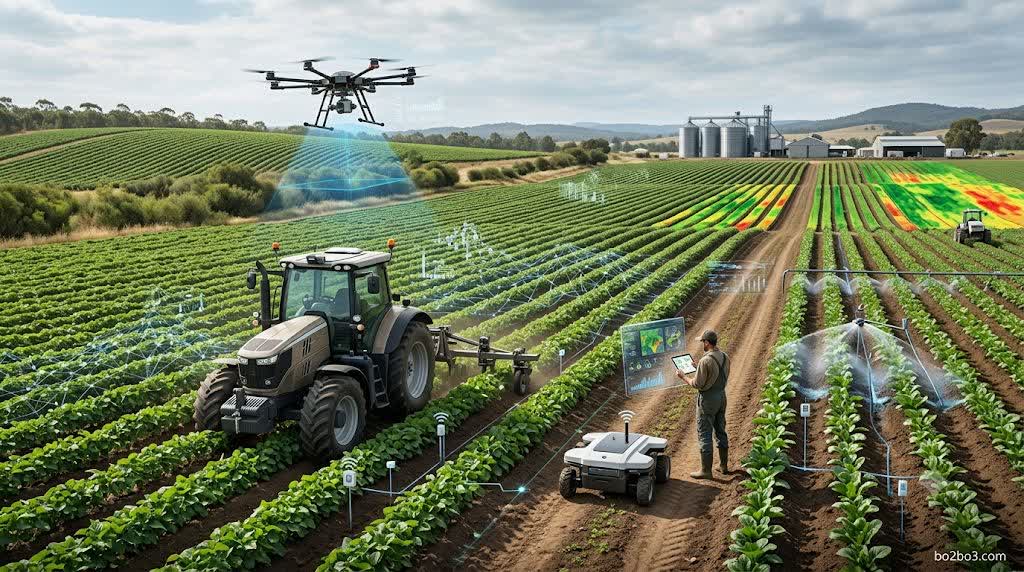
Artificial Intelligence in Agriculture: How AI Is Transforming Modern Farming
Artificial Intelligence (AI) is rapidly transforming modern agriculture. Technologies such as machine learning, computer vision, drones, satellite imagery, robotics, Internet of Things (IoT) sensors, and predictive analytics are helping farmers make faster and more informed decisions.
From monitoring crop health and detecting plant diseases to optimizing irrigation, predicting crop yields, and automating agricultural machinery, AI is becoming an important part of the future of farming.
According to the Food and Agriculture Organization of the United Nations (FAO), digital technologies and artificial intelligence can support more efficient, resilient, inclusive, and sustainable agrifood systems.
What Is Artificial Intelligence in Agriculture?
Artificial intelligence in agriculture refers to the use of AI technologies to analyze agricultural data, recognize patterns, make predictions, and support or automate farming decisions.
A modern farm can generate huge amounts of information from soil sensors, weather stations, drones, satellites, GPS systems, irrigation equipment, farm machinery, and crop monitoring applications.
AI can process this information much faster than humans and identify patterns that may be difficult to detect through traditional farming methods.
For example, an AI system can analyze satellite or drone images to identify areas of a field where crops are experiencing stress. It can then help farmers determine where additional irrigation, fertilizer, or inspection may be necessary.
Why Is AI Important for Modern Agriculture?
Agriculture faces many challenges, including climate change, water scarcity, soil degradation, increasing production costs, labor shortages, pests, plant diseases, and growing food demand.
At the same time, farmers have access to more data than ever before.
The challenge is transforming this data into useful information.
AI provides a way to analyze large datasets and turn them into predictions, recommendations, and automated actions.
The FAO Digital Agriculture and AI Innovation program highlights applications ranging from precision farming and climate-smart agriculture to supply-chain optimization and improved market access.
How AI Is Used in Agriculture
1. Precision Agriculture
Precision agriculture is one of the most important applications of artificial intelligence in farming.
Traditional farming methods often treat an entire field as one unit. However, soil moisture, nutrient levels, crop health, and soil properties can vary significantly within the same field.
AI can analyze these variations and help farmers apply water, fertilizer, pesticides, and other inputs more precisely.
This approach can reduce waste while improving resource efficiency.
2. Crop Health Monitoring
AI-powered crop monitoring systems can analyze images collected by drones, satellites, agricultural cameras, and smartphones.
Computer vision algorithms can identify changes in plant color, growth patterns, leaf structure, and vegetation indices.
This allows farmers to identify potentially problematic areas before problems spread across an entire field.
The FAO Agro-informatics platform also highlights the importance of satellite imagery, remote sensing, geographic information systems, artificial intelligence, and machine learning for agricultural data analysis.
3. Plant Disease Detection
Plant diseases can cause significant crop losses when they are not detected early.
Artificial intelligence and computer vision can analyze photographs of leaves, stems, fruits, and other plant components to identify visual patterns associated with diseases.
A farmer can potentially use a smartphone camera to capture an image of a plant and submit it to an AI-based system for analysis.
However, AI-based diagnosis should be considered a decision-support tool rather than a replacement for professional agricultural advice, especially when the economic consequences of an incorrect diagnosis are significant.
4. Weed Detection
AI can also help farmers identify weeds.
Computer vision systems mounted on tractors, drones, or agricultural robots can analyze images and distinguish crops from unwanted plants.
This technology can support targeted weed control instead of treating an entire field uniformly.
In some agricultural systems, precision spraying can potentially reduce unnecessary herbicide applications and lower input costs.
5. Smart Irrigation
Water management is one of the most promising applications of AI in agriculture.
AI-powered irrigation systems can combine soil moisture measurements, weather forecasts, crop information, evapotranspiration estimates, and historical irrigation data.
The resulting analysis can help determine when irrigation is required and how much water may be appropriate.
Smart irrigation can also detect unusual water consumption patterns that may indicate leaks, damaged pipes, or irrigation-system failures.
6. Fertilizer Optimization
Applying too little fertilizer can reduce crop productivity, while applying too much can increase costs and contribute to environmental problems.
AI can combine soil-test results, crop information, satellite imagery, historical yield data, and other variables to support more precise nutrient management.
Instead of applying the same amount of fertilizer across an entire field, farmers can potentially create variable-rate application plans based on local field conditions.
7. Crop Yield Prediction
Crop yield prediction is another important application of machine learning.
AI models can analyze historical yield data together with weather information, soil characteristics, satellite imagery, crop conditions, and farming practices.
Accurate yield prediction can help farmers plan harvesting, storage, transportation, labor requirements, and marketing.
Researchers are increasingly investigating machine-learning methods for crop-yield prediction and agricultural forecasting.
8. Weather and Climate Risk Analysis
Weather conditions have always been one of the largest sources of uncertainty in agriculture.
AI can analyze large quantities of historical and real-time weather data to help estimate agricultural risks.
Potential applications include predicting drought conditions, heat stress, frost, excessive rainfall, and other weather-related risks.
AI cannot eliminate weather uncertainty, but it can help farmers prepare for possible scenarios.
9. Agricultural Robotics
Artificial intelligence is increasingly being combined with agricultural robots.
Autonomous machines can potentially perform tasks such as planting, harvesting, weeding, spraying, crop monitoring, and transportation.
Computer vision allows robots to recognize plants, fruits, weeds, obstacles, and other objects in agricultural environments.
As robotics technology develops, autonomous agricultural machinery could become increasingly common on large farms and eventually become more accessible to smaller operations.
10. Livestock Monitoring
AI is not limited to crop production.
Livestock farms can use cameras, sensors, GPS devices, and other monitoring technologies to collect information about animal movement, feeding behavior, activity, and environmental conditions.
Machine-learning algorithms can analyze these patterns and identify unusual behavior that could indicate illness, injury, stress, or other problems.
AI, Drones, and Agriculture
Drones provide farmers with a fast way to collect high-resolution images of agricultural fields.
When combined with artificial intelligence, drone imagery can be transformed into useful agricultural information.
AI systems can analyze images to identify crop stress, weed infestations, water-related problems, vegetation differences, and other field conditions.
Instead of manually inspecting every part of a large farm, farmers can use AI-generated maps to identify areas that require closer investigation.
AI and Satellite Imagery
Satellite imagery is another important source of agricultural information.
Satellites can repeatedly observe large agricultural regions and provide information about vegetation and environmental changes.
Artificial intelligence can analyze this imagery over time and identify patterns that may indicate changes in crop conditions.
The FAO Agro-informatics initiative provides resources related to agricultural data, remote sensing, geospatial technologies, AI, and machine learning.
AI and the Internet of Things in Smart Farming
The Internet of Things, commonly known as IoT, allows agricultural sensors and devices to communicate with digital systems.
Examples include:
- Soil moisture sensors
- Temperature sensors
- Humidity sensors
- Weather stations
- Water-flow meters
- GPS devices
- Livestock monitoring devices
- Smart irrigation controllers
AI can analyze the data collected by these devices and transform measurements into useful recommendations.
This creates an intelligent feedback system in which sensors collect information, AI analyzes the information, and agricultural equipment can respond to changing conditions.
Generative AI in Agriculture
Generative AI is opening another area of innovation in agriculture.
Large language models can potentially help farmers access agricultural knowledge, summarize technical documents, organize farm records, analyze information, and communicate with agricultural advisory services.
AI assistants could also provide farmers with localized information about weather, crop management, irrigation, pests, diseases, and agricultural practices.
However, generative AI can sometimes produce incorrect or misleading information. Agricultural recommendations should therefore be checked against reliable scientific and local sources.
Benefits of Artificial Intelligence in Agriculture
Higher Productivity
AI can help farmers identify problems earlier and improve resource-management decisions.
Better Water Management
AI-based irrigation systems can use real-time and historical information to support more precise irrigation decisions.
Reduced Input Waste
Precision application of fertilizers, pesticides, and water can reduce unnecessary resource use.
Early Disease Detection
Computer vision can help identify potential disease symptoms before they become widespread.
Improved Farm Management
AI can transform large amounts of agricultural data into understandable reports, predictions, and recommendations.
Labor Support
Automation and robotics can reduce the amount of repetitive manual work required for certain agricultural tasks.
Improved Sustainability
More efficient use of water, fertilizer, pesticides, and energy can support sustainable agricultural production.
Challenges of AI in Agriculture
High Initial Costs
Advanced sensors, drones, robots, connectivity infrastructure, and AI software can require significant investment.
Data Quality
AI models depend on high-quality data. Poor, incomplete, biased, or incorrectly labeled data can result in inaccurate predictions.
Internet Connectivity
Some rural areas still have limited access to reliable internet connectivity, which can make cloud-based agricultural AI systems difficult to use.
Technical Skills
Farmers and agricultural workers may need training to operate digital systems and interpret AI-generated recommendations.
Data Privacy
Agricultural data can have significant commercial value. Farmers need clear information about who owns their data, who can access it, and how it will be used.
The FAO Digital Agriculture and AI Innovation Roadmap emphasizes responsible governance principles including accountability, equity, efficiency, security, and data stewardship.
AI Accuracy
An AI model trained in one geographic region may not work equally well in another region.
Differences in climate, soil, crop varieties, pests, diseases, and farming practices can significantly affect AI performance.
The Digital Divide
One of the most important challenges is ensuring that AI technologies are accessible to small farms and rural communities, rather than benefiting only large agricultural operations.
AI and Sustainable Agriculture
Artificial intelligence can contribute to sustainable agriculture by helping farmers use natural resources more efficiently.
Potential applications include precision irrigation, targeted fertilizer application, improved pest management, crop monitoring, soil analysis, and climate-risk prediction.
The FAO identifies digital agriculture and AI as important technologies for developing more efficient, resilient, and sustainable agrifood systems.
The Future of AI in Agriculture
The future of farming is likely to involve increasingly connected agricultural systems.
Future farms may combine:
- Artificial intelligence
- Machine learning
- Robotics
- Internet of Things sensors
- Satellite imagery
- Drones
- Cloud computing
- Edge computing
- Digital twins
- Autonomous agricultural machinery
These technologies could eventually operate as integrated intelligent farming ecosystems.
The FAO Digital Agriculture and AI Innovation Roadmap, published in 2025, describes a framework for moving beyond isolated digital-agriculture projects toward collaborative and scalable AI innovation.
Will Artificial Intelligence Replace Farmers?
AI is unlikely to completely replace farmers.
Agriculture depends on local knowledge, biological processes, weather conditions, economic decisions, and practical experience.
Instead of replacing farmers, AI is more likely to become a powerful decision-support and automation tool.
Farmers can continue making important decisions while AI helps them analyze large datasets, identify patterns, predict risks, and automate repetitive tasks.
The USDA Artificial Intelligence Strategy focuses on responsible AI use to support farmers, ranchers, producers, and rural communities.
How Small Farms Can Start Using AI
Farmers do not need expensive autonomous robots to begin using AI.
A practical starting point can involve simple digital technologies:
- Use reliable digital weather services.
- Record crop yields digitally.
- Collect basic soil information.
- Use affordable soil-moisture sensors.
- Monitor crops using smartphone images.
- Use satellite imagery when available.
- Analyze farm records with AI tools.
- Gradually introduce automated irrigation.
The most important principle is to start with a real agricultural problem rather than purchasing technology simply because it is marketed as AI.
Conclusion
Artificial intelligence is becoming one of the most important technologies in the digital transformation of agriculture.
AI can support precision farming, smart irrigation, crop monitoring, disease detection, weed management, yield prediction, livestock monitoring, robotics, and agricultural decision-making.
By combining AI with sensors, drones, satellites, IoT devices, and agricultural knowledge, farmers can potentially use water, fertilizer, pesticides, labor, and machinery more efficiently.
However, AI is not a magic solution. Data quality, cost, connectivity, technical skills, privacy, model accuracy, and unequal access remain important challenges.
The future of agriculture will likely depend on combining human experience with intelligent technology. Farmers provide local knowledge and practical judgment, while AI can provide powerful tools for analyzing complex information and predicting potential problems.
As AI continues to develop, the most successful agricultural technologies will be those that solve real problems, work reliably under local conditions, remain accessible, and are developed responsibly.
Frequently Asked Questions
What is artificial intelligence in agriculture?
Artificial intelligence in agriculture is the use of AI, machine learning, computer vision, sensors, robotics, and agricultural data to improve farming decisions and automate agricultural tasks.
How does AI help farmers?
AI can help farmers monitor crops, detect diseases, predict yields, optimize irrigation and fertilizer use, identify weeds, analyze weather information, and automate certain agricultural operations.
Can AI reduce water use in agriculture?
AI can support precision irrigation by analyzing soil moisture, weather, crop conditions, and historical irrigation data. Actual water savings depend on the crop, climate, irrigation system, and quality of the data.
Can AI detect plant diseases?
Yes. Computer-vision systems can analyze plant images and identify visual patterns associated with some diseases. Accuracy depends on crop type, disease, image quality, training data, and local conditions.
Will AI replace farmers?
AI is more likely to assist farmers than completely replace them. Agricultural decisions require local knowledge, experience, and understanding of changing environmental conditions.
Is AI useful for small farms?
Yes. Small farms can start with relatively simple technologies such as smartphone applications, digital weather services, soil sensors, satellite imagery, and AI-based farm-management tools.
References and Further Reading
