The Role of Artificial Intelligence in Everyday Life
Artificial Intelligence (AI) is rapidly changing the way people live, work, learn, communicate, shop, travel, and use digital services. What once seemed
like futuristic technology has become an increasingly common part of everyday life.
From smartphones and search engines to online shopping, streaming platforms, navigation applications, smart homes, education, healthcare, banking, and cybersecurity, artificial intelligence is working behind many of the digital services people use every day.
Many people interact with AI without even realizing it. When a smartphone automatically improves a photograph, a streaming service recommends a movie, a navigation application predicts traffic, or an online store recommends a product, artificial intelligence may be involved in the process.
This article explores the role of artificial intelligence in everyday life, including its most common applications, benefits, limitations, privacy concerns, security risks, and potential impact on the future.
How Artificial Intelligence Is Changing Daily Life
Artificial intelligence allows computer systems to analyze information, recognize patterns, make predictions, understand language, and generate content.
These capabilities make it possible for software and devices to provide more personalized and automated services.
Modern AI systems can process enormous amounts of information in a relatively short period of time. As a result, companies and developers can use AI to automate repetitive processes and provide users with services that are more personalized and responsive.
The influence of AI can be seen in many areas of everyday life, from the moment a person wakes up and checks a smartphone to the time they search for information, communicate with friends, travel, shop online, or watch
entertainment.
AI in Smartphones
Smartphones are among the most common examples of artificial intelligence in everyday life. Modern smartphones use AI and machine learning for a wide range of functions.
- Face recognition and biometric authentication
- Voice recognition
- Predictive text and autocorrection
- Camera and image enhancement
- Object and scene recognition
- Battery optimization
- Personalized recommendations
- Translation and accessibility features
AI-powered camera systems can recognize scenes, faces, objects, and lighting conditions and use this information to improve photographs. Smartphone assistants can also understand spoken commands and perform tasks such as setting reminders, searching for information, or controlling compatible devices.
AI in Search Engines
Search engines use sophisticated algorithms and machine-learning technologies to understand queries and deliver relevant information.
Instead of simply matching individual keywords, modern search systems can attempt to understand the meaning and context of a user’s query. AI can also help identify relationships between topics and improve the relevance of search results.
Artificial intelligence is therefore becoming an important part of how people discover information online.
AI in Social Media
Social media platforms use AI to personalize the content users see. Machine-learning systems can analyze interactions such as likes, searches, views, follows, and other signals to determine which content may be relevant to a particular user.
AI can also be used for content moderation, spam detection, recommendation systems, image recognition, advertising, and identifying potentially harmful activities.
Although personalization can make social platforms easier to use, it also raises questions about privacy, transparency, recommendation algorithms, and the potential creation of information bubbles.
AI in Streaming Services
Streaming platforms use recommendation algorithms to suggest movies, TV programs, music, podcasts, and other content.
These systems can analyze viewing or listening patterns and compare them with the behavior of other users. The resulting recommendations help platforms personalize the user experience.
AI can therefore influence what people watch, listen to, and discover online.
AI in Online Shopping
Artificial intelligence has become an important part of modern e-commerce. Online stores use AI to recommend products, predict customer preferences, improve search results, detect fraudulent transactions, and optimize inventory.
For example, when an online store recommends products based on previous searches or purchases, a machine-learning system may be analyzing customer behavior to generate those recommendations.
AI-Powered Customer Service
AI chatbots and virtual assistants can answer frequently asked questions, provide product information, help users navigate websites, and assist with basic customer-service tasks.
This allows businesses to provide support at any time while reducing the amount of repetitive work handled by human employees.
AI in Navigation and Maps
Navigation applications use data analysis and machine learning to provide directions, estimate travel times, identify traffic conditions, and recommend alternative routes.
By processing information from roads, traffic conditions, historical patterns, and other sources, AI-powered systems can help users choose efficient routes.
In the future, increasingly intelligent transportation systems may use AI to coordinate traffic, improve public transportation, and support autonomous vehicles.
AI in Smart Homes
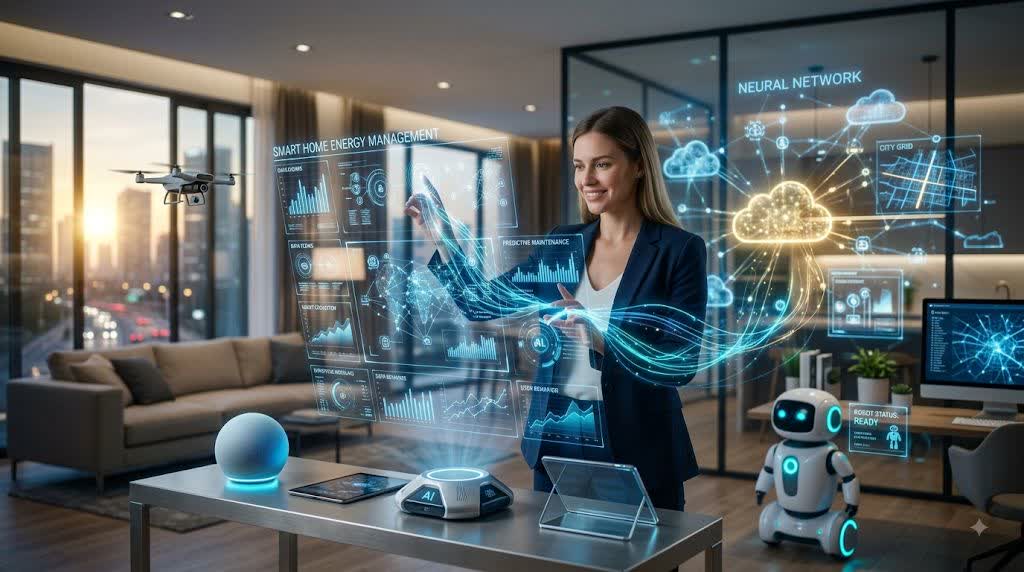
Artificial intelligence is also becoming increasingly common in smart homes. Smart speakers, security systems, thermostats, cameras, lighting systems, and other connected devices can use AI to automate household tasks.
For example, a smart system may learn user preferences and automatically adjust lighting or temperature. AI-powered security cameras may also detect objects or unusual activity.
However, connected devices can collect sensitive information, making privacy and cybersecurity important considerations.
AI in Work and Productivity
Artificial intelligence is changing the modern workplace by automating repetitive tasks and helping employees process information.
AI tools can assist with:
- Writing and editing
- Data analysis
- Research
- Translation
- Programming
- Email and document processing
- Customer support
- Meeting summaries
- Project organization
AI does not necessarily replace an entire job. In many cases, it automates specific tasks and allows people to spend more time on activities that require judgment, creativity, communication, or specialized knowledge.
AI in Education
Artificial intelligence is transforming education by enabling more personalized learning experiences.
AI-powered educational systems can analyze a student’s performance and recommend exercises, explanations, or learning materials based on individual needs.
Students can also use AI tools to explain difficult concepts, practice languages, generate study questions, summarize information, and receive interactive assistance.
However, students should learn to evaluate AI-generated information rather than accepting every answer without verification. AI systems can produce incorrect or misleading information.
AI in Healthcare
Healthcare is one of the areas where artificial intelligence has significant potential. AI can assist with medical image analysis, research, administrative tasks, patient-data analysis, and drug discovery.
Machine-learning systems can analyze large datasets and identify patterns that may be difficult to detect manually. AI can therefore serve as a tool for supporting healthcare professionals.
However, medical decisions involve significant risks, and AI-generated recommendations should not automatically replace qualified professional judgment.
AI in Banking and Finance
Banks and financial organizations use artificial intelligence for fraud detection, transaction monitoring, customer service, risk analysis, and financial forecasting.
AI can examine large numbers of transactions and identify unusual patterns that may indicate fraudulent activity.
Financial institutions can also use machine learning to automate certain processes and improve customer experiences.
AI in Transportation
Artificial intelligence plays an increasingly important role in transportation and mobility.
AI can be used for:
- Traffic prediction
- Route optimization
- Fleet management
- Driver-assistance systems
- Vehicle safety systems
- Autonomous-driving research
- Public transportation optimization
By combining information from sensors, maps, vehicles, weather conditions, and traffic systems, AI can help improve transportation efficiency and safety.
AI in Cybersecurity
Cybersecurity is another major area where artificial intelligence is becoming increasingly important.
Security systems can use machine learning to identify unusual network behavior, detect potential malware, analyze security events, and prioritize alerts.
AI can process enormous amounts of security data and identify patterns that might otherwise be difficult for security teams to discover quickly.
However, attackers can also use AI to automate certain malicious activities. This means organizations need strong security controls and continuous monitoring when deploying AI systems.
AI in Entertainment
Artificial intelligence is changing entertainment through personalized recommendations, content creation, visual effects, audio processing, and interactive experiences.
Generative AI can create text, images, music, computer code, and other forms of digital content. These technologies are creating new opportunities for artists, developers, designers, writers, and other creative professionals.
At the same time, AI-generated content raises important questions about copyright, originality, attribution, and the future of creative work.
AI Personal Assistants
AI assistants can understand natural-language commands and help users perform various tasks.
Depending on the system, an AI assistant may help with searching for information, writing text, planning tasks, summarizing documents, answering questions, translating languages, or interacting with software.
The increasing ability of AI systems to understand natural language is making human-computer interaction more conversational and accessible.
Benefits of Artificial Intelligence in Everyday Life
1. Saving Time
AI can automate repetitive processes and help users complete tasks faster.
2. Increased Productivity
AI tools can assist with research, writing, programming, data analysis, and many other activities.
3. Personalization
AI can analyze user preferences and provide personalized recommendations and services.
4. Accessibility
AI can support accessibility through speech recognition, text-to-speech, automatic captions, translation, image descriptions, and other technologies.
5. Faster Information Processing
AI can process large amounts of information rapidly and identify patterns that may be difficult to find manually.
6. Automation
Businesses and individuals can use AI to automate routine processes and focus more attention on tasks requiring human judgment.
Privacy and Data Protection
One of the most important issues surrounding AI in everyday life is privacy. Many AI-powered services depend on large amounts of data, including information about user behavior and preferences.
Users should understand what information a service collects, why it is collected, how it is stored, and how it may be used.
Privacy protection should remain an important consideration throughout the development and use of AI systems. UNESCO’s global recommendation on AI ethics also emphasizes the right to privacy and data protection as a core principle for responsible AI.
UNESCO – Ethics of Artificial Intelligence
.
Security and Risks of AI
Artificial intelligence provides significant benefits, but it also introduces new risks.
- Incorrect or unreliable AI-generated information
- Privacy concerns
- Security vulnerabilities
- Algorithmic bias
- Deepfakes and misinformation
- Potential misuse of AI systems
- Overdependence on automated decisions
- Employment and workforce changes
Organizations should evaluate these risks throughout the AI lifecycle. The NIST AI Risk Management Framework was developed to help organizations incorporate trustworthiness considerations into the design, development, use, and evaluation of AI systems.
NIST AI Risk Management Framework
.
Responsible Artificial Intelligence
Responsible AI means developing and using artificial intelligence in ways that consider safety, privacy, fairness, transparency, accountability, and human oversight.
NIST’s AI Risk Management Framework is designed as a voluntary framework for helping organizations manage risks associated with AI and incorporate trustworthiness considerations into AI systems.
Read the NIST AI RMF 1.0
.
UNESCO’s Recommendation on the Ethics of Artificial Intelligence similarly emphasizes human rights and dignity, transparency, fairness, privacy, security, accountability, human oversight, sustainability, and non-discrimination.
Ethics of Artificial Intelligence in Everyday Life
The growing use of AI raises important ethical questions. People need to know when automated systems are making decisions that affect them, how their data is being used, and whether those systems are producing unfair outcomes.
UNESCO adopted its Recommendation on the Ethics of Artificial Intelligence in 2021 as a global standard for AI ethics. Its approach places human rights and human dignity at the center of responsible AI development and emphasizes principles including transparency, fairness, privacy, safety, accountability, and human oversight.
Read the UNESCO Recommendation on the Ethics of AI
.
Can Artificial Intelligence Replace Humans?
Artificial intelligence can outperform humans in some specific tasks, especially when analyzing large datasets or performing repetitive operations. However, this does not mean that AI can replace human intelligence in every area.
Human creativity, experience, communication, emotional understanding, judgment, and responsibility remain important in many situations.
The future of work is therefore likely to involve increasing collaboration between humans and AI rather than simple replacement of humans by machines.
How AI May Change Everyday Life in the Future
Artificial intelligence is expected to become increasingly integrated into digital services, workplaces, homes, transportation systems, education, and healthcare.
Future AI systems may provide more personalized digital assistants, smarter homes, improved accessibility tools, advanced robotics, intelligent transportation, and more sophisticated systems for scientific research.
AI may eventually become less visible as a separate technology and more like an underlying capability integrated into many products and services.
However, technological progress should be accompanied by appropriate governance, security, privacy protection, testing, and human oversight.
How to Use AI Responsibly in Everyday Life
Individuals can take several simple steps to use AI more responsibly:
- Do not share unnecessary sensitive personal information with AI systems.
- Verify important AI-generated information.
- Understand the privacy policies of AI-powered services.
- Use strong passwords and appropriate security controls.
- Be cautious with AI-generated images, videos, and news.
- Do not rely exclusively on AI for high-stakes decisions.
- Keep human judgment involved when important consequences are possible.
Artificial Intelligence and the Future of Human-AI Collaboration
The most useful way to think about AI may not be as a replacement for people, but as a technology that can extend human capabilities.
A doctor may use AI to analyze information, an engineer may use AI to explore design alternatives, a teacher may use AI to create learning materials, and a developer may use AI to assist with programming.
In these situations, AI can provide speed and computational capabilities while humans provide context, responsibility, judgment, and creativity.
Frequently Asked Questions About Artificial Intelligence in Everyday Life
What is artificial intelligence?
Artificial intelligence is a field of technology that enables computer systems to perform tasks associated with human intelligence, including recognizing patterns, understanding language, learning from data, making predictions, and generating content.
How is AI used in everyday life?
AI is used in smartphones, search engines, social media, streaming services, online shopping, navigation applications, smart homes, banking, education, healthcare, cybersecurity, and many other areas.
Is AI already part of everyday life?
Yes. Many people already interact with AI through smartphones, recommendation systems, search engines, voice assistants, navigation systems, online stores, and other digital services.
Does AI make everyday life easier?
AI can save time, automate repetitive tasks, personalize services, process information quickly, and assist people with many everyday activities.
What are the disadvantages of AI?
Potential disadvantages include privacy concerns, incorrect information, algorithmic bias, cybersecurity risks, misinformation, misuse, and changes to some jobs and professional tasks.
Can AI replace human workers?
AI may automate certain tasks and change the way some jobs are performed. However, many occupations require human judgment, creativity, communication, responsibility, and domain expertise.
Is AI safe?
The safety of AI depends on how a system is designed, trained, tested, deployed, and monitored. Responsible AI development requires risk management, security controls, human oversight, and continuous evaluation.
Why is privacy important when using AI?
AI-powered services may process personal or behavioral information. Users should therefore understand what data is collected and how it is used, stored, and protected.
What is the future of AI in everyday life?
AI is likely to become more deeply integrated into smartphones, homes, transportation, education, healthcare, workplaces, entertainment, and online services. Human oversight and responsible development will remain important as these technologies evolve.
Conclusion
Artificial intelligence is no longer simply a futuristic concept. It is already an important part of everyday life and is influencing how people work, learn, communicate, travel, shop, consume entertainment, and access information.
From smartphone cameras and search engines to navigation systems, online shopping, education, healthcare, finance, cybersecurity, and smart homes, AI is becoming increasingly integrated into modern society.
The benefits of AI include automation, personalization, productivity, accessibility, and faster information processing. At the same time, privacy, security, bias, misinformation, and responsible use remain important challenges.
As artificial intelligence continues to evolve, the most valuable approach will be to combine technological innovation with human judgment, transparency, security, privacy protection, and responsible governance.
Understanding the role of artificial intelligence in everyday life can help individuals and organizations make better decisions about how to use AI effectively and responsibly.
References and Further Reading
